How Solwise Works
Solwise teaches two maps: Spain, with its 17 autonomous communities and 2 autonomous cities, and Latin America, with the 18 Spanish-speaking countries of the Americas and Puerto Rico, plus Equatorial Guinea on a small map of Africa. Both maps are open from the first visit. Pick a map, pick one of six short games, pick a set of places and press Start. A round ends when every place in the set has been answered.
- Pick a map. Tap Spain or Latin America at the top of the start screen.
- Pick a game. The six games are grouped by age: Little Explorers (grades K to 2), Map Masters (grades 3 to 5) and Capital Champs (grades 6 to 8).
- Pick a set. Quick 8 is eight places. The regional sets are one part of the map, such as The North or The Caribbean. All is the whole map.
- Answer. Tap the map, drag a puzzle piece, or pick one of four answers. In the four-answer games a miss shows the right answer at once; Find the Place and Map Puzzle give a second try first. Except in Map Puzzle, a place you missed comes back later in the round.
On a phone or tablet, tap a place, drag the map to move it, and pinch to zoom. Very small places, such as Ceuta and Melilla, get a round tap circle; a tap on a crowd of circles zooms in first. With a mouse, click a place, drag the background to pan and use the wheel to zoom. On a keyboard, 1 to 4 pick an answer, Esc or P pauses, the arrow keys pan, + and − zoom and F fits the whole map. In Find the Place, Tab moves through the places on the map and Enter picks one. The Fit button in the corner of the map always brings the whole map back.
Advanced Guide to Solwise
The Six Games
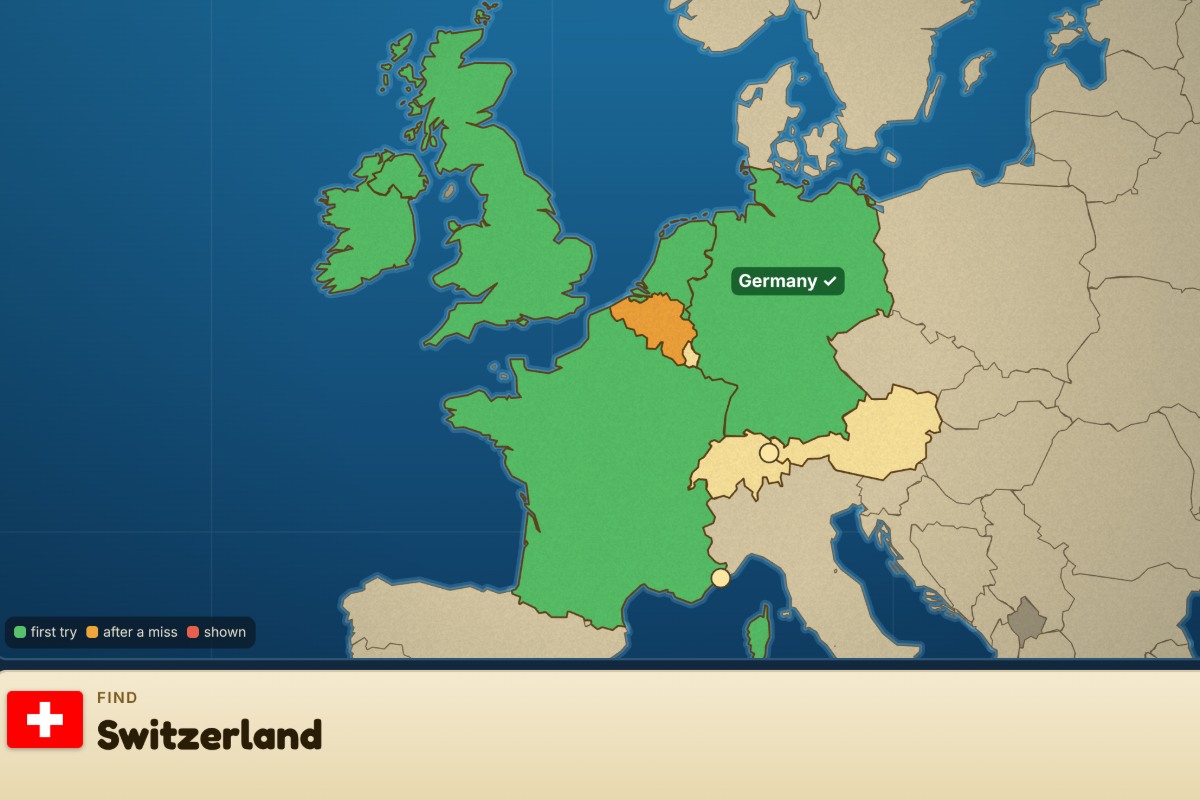
Find the Place shows a name, such as "Find Andalusia.", and you tap it on a map tinted lightly by region. A wrong tap writes the name of the place you tapped onto the map and leaves the question up. After a second wrong tap the right place glows; tap it to go on, and it comes back later in the round. Map Puzzle starts with dotted outlines. Drag the piece from the tray onto its slot, or tap the piece and then tap the slot. A wrong drop says whose slot it was, and after two wrong drops the right slot glows. A piece can be skipped and placed later in the round. On a phone, dragging toward a small island zooms the map in first.
Name the Place lights up one place on a plain map; pick its name from four answers. Where the map allows, at least two of the wrong answers come from the same part of the map, so knowing the continent is not enough. Shape Detective shows only an outline with no neighbors; pick its name from four, and then the place lights up on the full map. The islands and the autonomous cities are in it too. Capital Quiz mixes two kinds of card: "What is the capital of Colombia?", with four cities, and "Santo Domingo is the capital of which place?", answered by tapping the map or picking a name. Famous cities that are not capitals, such as Guayaquil, Bilbao or Córdoba, are often among the wrong answers. Capital Match deals four places and four capitals as cards. Tap a place, then its capital. A wrong pair adds three seconds to your time, and when all four pairs are done the next four appear until the set is finished. It is the only timed game.
Points and Stars
A right answer on the first try earns 100 points. In Find the Place and Map Puzzle a right answer on the second try earns 40, and a puzzle piece placed after the slot glows earns 25. In the four-answer games a miss shows the right answer, and so does a second miss in Find the Place. That place then comes back later in the round, where a right answer earns 25. A place comes back at most twice. Stars come from first tries: 3 stars for at least 90 percent, 2 stars for at least 70 percent and 1 star for finishing, with a bonus of 300, 200 or 100 points. In Capital Match the stars come from your time against a par of 8 seconds a pair on the All sets, 6 on Quick 8 and 7 on the regional sets: 3 stars at or under par and 2 stars within one and a half times par. Every tenth of a second under par adds a point.
The Sets, the Leaderboard and Equatorial Guinea
Spain has Quick 8, The North, The Interior, The Mediterranean and South, Islands and autonomous cities, and All 19. Latin America has Quick 8, Mexico and Central America, The Caribbean, The Andes and the coast, The Southern Cone and the east, All 19, Across the ocean and All 20. Chile is in two of the study sets but is asked once in an All round. Quick 8 uses your practice list for that map when it has eight or more places. The optional leaderboard takes only three kinds of round, All 19 Spain, All 19 Americas and All 20, and the results screen says so. Equatorial Guinea is never drawn on the map of the Americas. In Across the ocean and All 20 its card comes last, on a small map of the Gulf of Guinea with its own label, because it is in Africa and is in the game only because Spanish is one of its official languages.
Explore, Practice, the Daily Round and the Journal
Explore is open from the start. Tap a place to see and hear its name and capital; Show names writes on the map every name that has room at the current zoom, and a small globe in the corner shows where the map sits in the world. On the English page Explore also gives the Spanish name and co-official names such as Catalunya, Euskadi and Illes Balears. Neighbors such as Portugal, France, Morocco and Brazil are drawn in gray and named when tapped, and they are never asked. Practice missed is up to eight cards from the places and capitals you missed most. The Daily round is eight cards picked from the date, mixed from the maps you have played and from the games in the age group of the game you played last; Capital Match is left out because it is timed. Finishing it on days in a row builds a streak. The Journal has a Spain page, a Latin America page and a capitals page. A place gets a stamp when you answer it right on the first try on two different days, and capitals get their own stamps.
Parent and Teacher Guide
If you know Statewise, you already know how to play. Solwise uses the same three age bands and the same kinds of games, so a family or a class can stay in one game from early elementary school through middle school. Little Explorers (grades K to 2) uses tinted maps and puzzle pieces with names, and read-aloud is on for those games, Explore and the Journal unless you change it. Map Masters (grades 3 to 5) works on names and shapes. Capital Champs (grades 6 to 8, and ready grade 5 students) works on capitals. The read-aloud button in the top bar has three settings, K-2, All and Off, and it is hidden when the device has no voice.
In the United States the game fits elementary and middle school world geography and Latin America units, and the C3 Framework geography standards on using maps to locate places: D2.Geo.1.K-2 and D2.Geo.2.K-2, D2.Geo.1.3-5 and D2.Geo.2.3-5, and D2.Geo.1.6-8 and D2.Geo.2.6-8. It also suits Spanish-language and bilingual classrooms, where the Spanish page uses Spanish names throughout. In Spain it supports the Conocimiento del Medio and Ciencias Sociales work in Educación Primaria on how the Spanish state is organized into comunidades autónomas and on locating the countries of America, and it works as review for ESO geography.
A few things can surprise a class, so here they are. The Canary Islands have two capitals, Las Palmas de Gran Canaria and Santa Cruz de Tenerife. Bolivia has a constitutional capital, Sucre, and a seat of government, La Paz. Equatorial Guinea is moving its capital from Malabo to Ciudad de la Paz, a new city on the mainland. In all three cases either city is a right answer and the game then names both. Puerto Rico is a territory of the United States, not a country; it is in the game because it is part of the Spanish-speaking Caribbean that classes study, and it is labeled as a US territory on every card, answer button and list where its name appears, and in Explore. This is a map-and-capitals game, not a history of colonization and not a flags game. For flags and the world map, try Globetrot. For the 50 United States, try Statewise. More are on the educational games page. Spain's 50 provinces and Mexico's 32 states are not in this version; more detailed maps may come later. There is no account and no chat, and the page shows no ads. Progress is saved in that browser only, so if a school clears browser data at sign-out, the Journal starts over.
Tips
- Start with Explore and Show names when a map is new, then play a regional set before All.
- On the Spain map, the Canary Islands are in the box at the lower left, and Ceuta and Melilla are in the two small boxes on the coast of Africa. Their dots near the Strait of Gibraltar work too.
- Cuba, the Dominican Republic and Puerto Rico run west to east. The Dominican Republic shares its island with Haiti, which is not in the game.
- Watch for famous cities that are not capitals: Bilbao, Málaga, Guayaquil, Medellín and Córdoba are all wrong answers you will meet.
- In Capital Match, a slow right pair beats a fast wrong one, because a wrong pair adds three seconds.
Map data: Spain's autonomous communities © Instituto Geográfico Nacional de España (CC BY 4.0, via es-atlas); other countries from Natural Earth (public domain, via world-atlas). Simplified for this game.
Frequently Asked Questions
Which places are in Solwise?
The Spain map has all 19 places: the 17 autonomous communities and the autonomous cities of Ceuta and Melilla. The Latin America map has Mexico, the six Spanish-speaking countries of Central America, Cuba, the Dominican Republic, Puerto Rico and the nine Spanish-speaking countries of South America. Equatorial Guinea is a 20th place in the Across the ocean and All 20 sets, shown on a small map of Africa. Brazil, Portugal and other neighbors are drawn in gray but are never asked.
Which game should my child start with?
For grades K to 2, start with Find the Place or Map Puzzle, in Quick 8 or a regional set. For grades 3 to 5, try Name the Place and Shape Detective. For grades 6 to 8, try Capital Quiz and then Capital Match, which is the only timed game. Every game and every set is open from the start (Capital Match leaves out Across the ocean, which has only one place), so you can move up or down at any time.
What happens after a wrong answer?
It depends on the game. In Find the Place a wrong tap names the place you tapped and you try again; after a second wrong tap the right place glows, and once you tap it, it comes back later in the round. In Map Puzzle a wrong drop says whose slot it was, and after two wrong drops the right slot glows; the piece does not come back. In Name the Place, Shape Detective and Capital Quiz a wrong pick shows the right answer, and that place comes back later in the round. In Capital Match a wrong pair adds three seconds and that place comes back in a later board. A miss lowers the points and stars for that round and adds the place to Practice missed. There are no lives and no game over.
Why do the Canary Islands and Bolivia have two capitals?
The Canary Islands share the capital between Las Palmas de Gran Canaria and Santa Cruz de Tenerife. Bolivia's constitutional capital is Sucre and its seat of government is La Paz. In Solwise either city is a right answer, and the game then says both.
Why is Puerto Rico in a game about countries?
Puerto Rico is a territory of the United States, not a country, and the game labels it a US territory on every card and answer button that names it, in lists such as the Journal, and in Explore. It is included because it is part of the Spanish-speaking Caribbean that classes study, alongside Cuba and the Dominican Republic.
How does a place get a stamp in the Journal?
A place is stamped when you answer it right on the first try on two different days, so a stamp means you still knew it the next time. Capitals have their own stamps on the capitals page, earned in Capital Quiz and Capital Match.
Can we play in Spanish?
Yes. The Spanish page has every card, hint and read-aloud line in Spanish, with Spanish names such as Andalucía, Cataluña and País Vasco, and it shows co-official names such as Catalunya and Euskadi in Explore.
Does it work on a Chromebook, tablet or phone?
Yes. The maps are flat 2D drawings that run in the browser on school Chromebooks, tablets and phones as narrow as 320 pixels, with large tap circles for small places. Once the page has loaded, the game does not need the internet; only the optional leaderboard does.